
In the quiet villages along Maharashtra’s Western Ghats, even the walls seem alive. Their language is neither written nor spoken but drawn—circles for the sun and moon, triangles for trees and mountains, and lines that move with the rhythm of life. This painting is Warli art, one of India’s oldest forms of visual storytelling. Today, as galleries and public initiatives showcase Warli paintings, issues of authenticity and livelihood emerge as key elements in their contemporary narrative. Its steady rise signals a renewed search for clarity, rootedness, and human connection in modern culture.
How might Warli’s quiet clarity reshape the way we look at the world today?
Warli Art: Key Takeaways
- Originated among the Warli tribe in Maharashtra.
- Uses geometric forms in figurative compositions.
- Painted with white rice paste on red earthen walls.
- Features daily life, animals, and ritual scenes.
- Seen in galleries, collaborations, and urban murals.
Cultural Roots: Origins & Symbolism
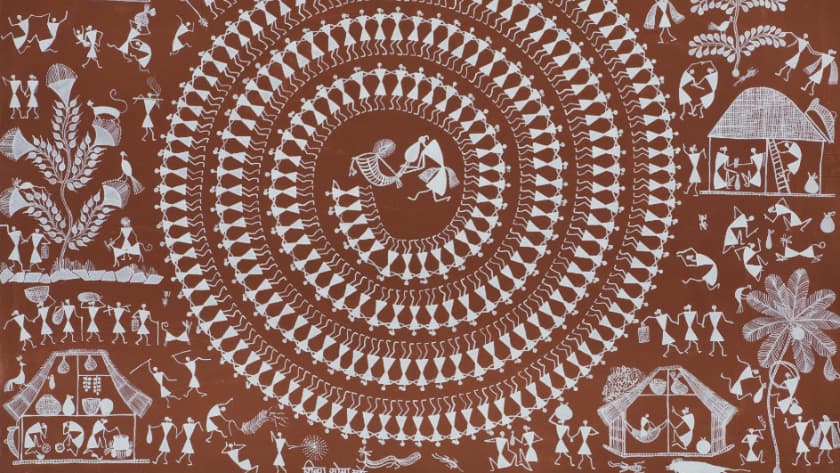
The Warli tribe, indigenous to the Sahyadri ranges of Maharashtra, developed a visual language that predates written records. Painted on the inner walls of earthen homes, these murals honored fertility, seasonal cycles, and the rhythm of agricultural life.
Warli’s visual grammar is strikingly simple yet symbolically layered: circular celestial bodies, triangular trees and mountains, and square sacred or ceremonial spaces. From these elemental shapes emerges a vibrant cosmos—dancers orbiting the Tarpa musician, farmers sowing seeds, animals moving in harmony.
Compositions traditionally begin with the Chaukat, a square representing the mother goddess Palaghata, revered as a life-giving force in Warli cosmology. These paintings historically appeared at weddings, harvest festivals, and Tarpa dance ceremonies. Traditional accounts describe how Tarpa music and dance were depicted on walls to mark the harvest and to invoke fertility during weddings.
Passed from mother to daughter, the murals preserved memory, belief, and community identity through image rather than script. In this early system, everyday life intertwined naturally with ritual meaning, forming the foundation for the craft’s enduring symbolic depth.
Craftsmanship: Tools & Techniques
Warli Painting – The Form of Tribal Art by D’source licensed under CC BY-NC-SA 4.0
Warli art painting begins with the earth itself. The traditional surface is a mud-plastered wall coated in a mixture of cow dung and red ochre, creating a warm, earthen background. On this, the artisans apply a handmade rice-paste pigment, often mixed with gum for binding, and painted using a chewed bamboo twig instead of a brush.
The natural contrast of white pigment on reddish earth produces a vivid surface ideal for fine linear work. Artists create their work without initial sketches, allowing each stroke to flow continuously without interruption. The rice pigment dries matte, the bamboo tip rasping faintly across the ochre, and the air holds a faint grain-sweet scent.
Precision arises from rhythm, memory, and the body’s trained instinct rather than measurement. Figures of daily life emerge—farmers, musicians, women grinding grain—woven together in spirals or flowing sequences like visual choreography. Subtle regional variations may occur in line weight, spacing, and compositional rhythm, shaped by local tools and soil textures.
Living Tradition: People & Expression
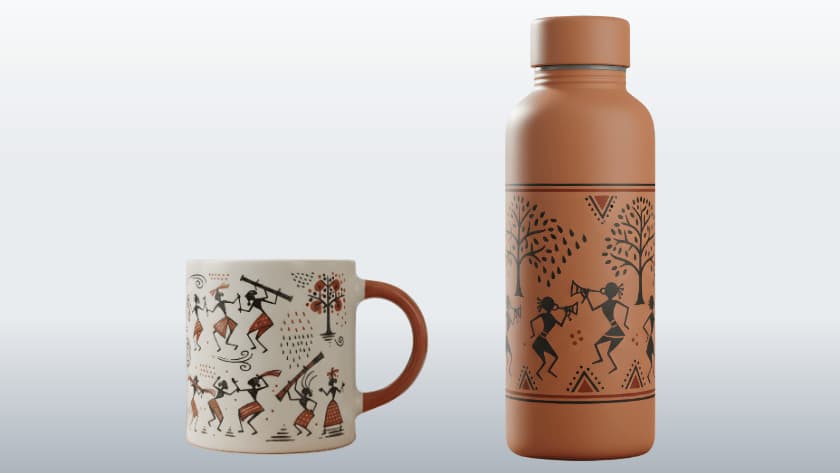
The heartbeat of Warli art still echoes through Dahanu, Palghar, and Talasari, where murals mark festivals, rituals, and life passages. Yet the art has also traveled. Visionary painter Jivya Soma Mashe brought Warli from hut walls to canvas and paper, earning recognition in national galleries and international museums. His work showed Warli not as “folk art” but as a profound system of line and form.
Across India today, Warli motifs enliven city murals, fashion textiles, and architectural façades, appearing in craft collaborations and commercial design contexts. NGOs train younger artisans to experiment with acrylics, fabrics, and digital tools, helping them adapt tradition to contemporary media.
Modern expressions feature expanded scenes, denser compositions, and playful scale shifts, reflecting evolving communal narratives. “The lines dance, even on concrete,” says a Palghar artisan. That dance—once ritual, now conversation—guides Warli’s growing presence across new visual landscapes.
Engaging Heritage: Ethics & Display
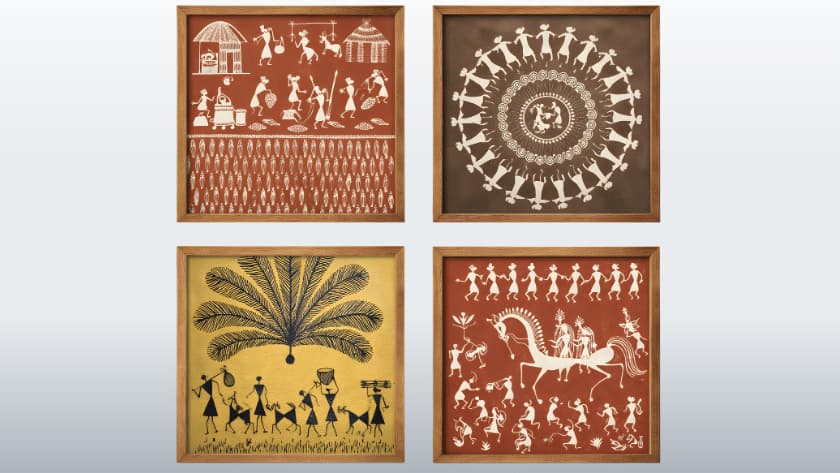
As Warli art enters international markets, authenticity and ethics matter more than ever. Mass-produced imitations of décor and souvenirs can erase both meaning and livelihood. Genuine Warli paintings reveal organic texture—the hand’s gentle tremor, the rice pigment’s uneven breath—distinguishing them from factory-made reproductions.
Buying from artisans, cooperatives, community-led groups, or verified fair-trade organizations helps ensure artists directly benefit from their work. These networks uphold the cultural integrity of the craft while offering economic stability for Warli families.
Displaying Warli art also calls for respect. These images arise from ritual contexts, not mere decorative impulses. Understanding their origins enriches the experience of living with them, grounding appreciation in awareness rather than assumption. Thoughtful engagement aligns ownership with cultural responsibility.
Preserving Tradition: Challenges & Revival
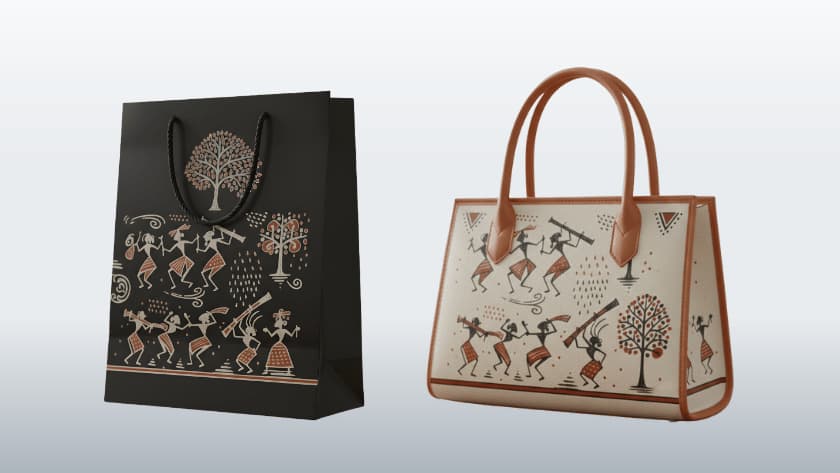
The future of Warli art balances promise and peril. Urban migration, commercial imitation, and shifting aspirations among younger generations have created real challenges for sustaining the practice. As cheap reproductions circulate in tourist markets, authentic work competes with items lacking cultural grounding or fair compensation.
Yet revival grows alongside risk. Cultural organizations, cooperatives, and educational initiatives in Maharashtra collaborate closely with Warli artists to enhance skills, create economic opportunities, and guard traditional knowledge. Community-run workshops and training programs help preserve traditional techniques while supporting new livelihoods.
A new generation of artists is now utilizing digital platforms and social media to connect with audiences, sell their art, and showcase their creative processes. This visibility helps counter exploitation while enabling artisans to explore new formats—from animation to eco-conscious art practices—without abandoning core symbolism.
Warli survives not by resisting change, but by adapting thoughtfully. Renewal becomes a living expression of collective resilience.
Warli Art: Reflection & Future
Every Warli line offers a lesson in restraint—a reminder that beauty and balance dwell in simplicity. Warli painting continues to convey a deep sense of connection, uniting humanity with nature and spirit. As the modern world seeks calm amid noise and excess, Warli’s quiet geometry offers both solace and direction.
Supporting artisans, attending exhibitions, or learning their craft becomes a small act of cultural continuity. Those spare, patient lines—first traced on earthen walls in the Western Ghats—still return us to a quiet landscape of meaning.
How might the enduring clarity of Warli art guide our efforts to sustain cultural continuity in a fragmented world?